
From Darkness to Light | Ravel, Mendelssohn, Schumann, Korngold
New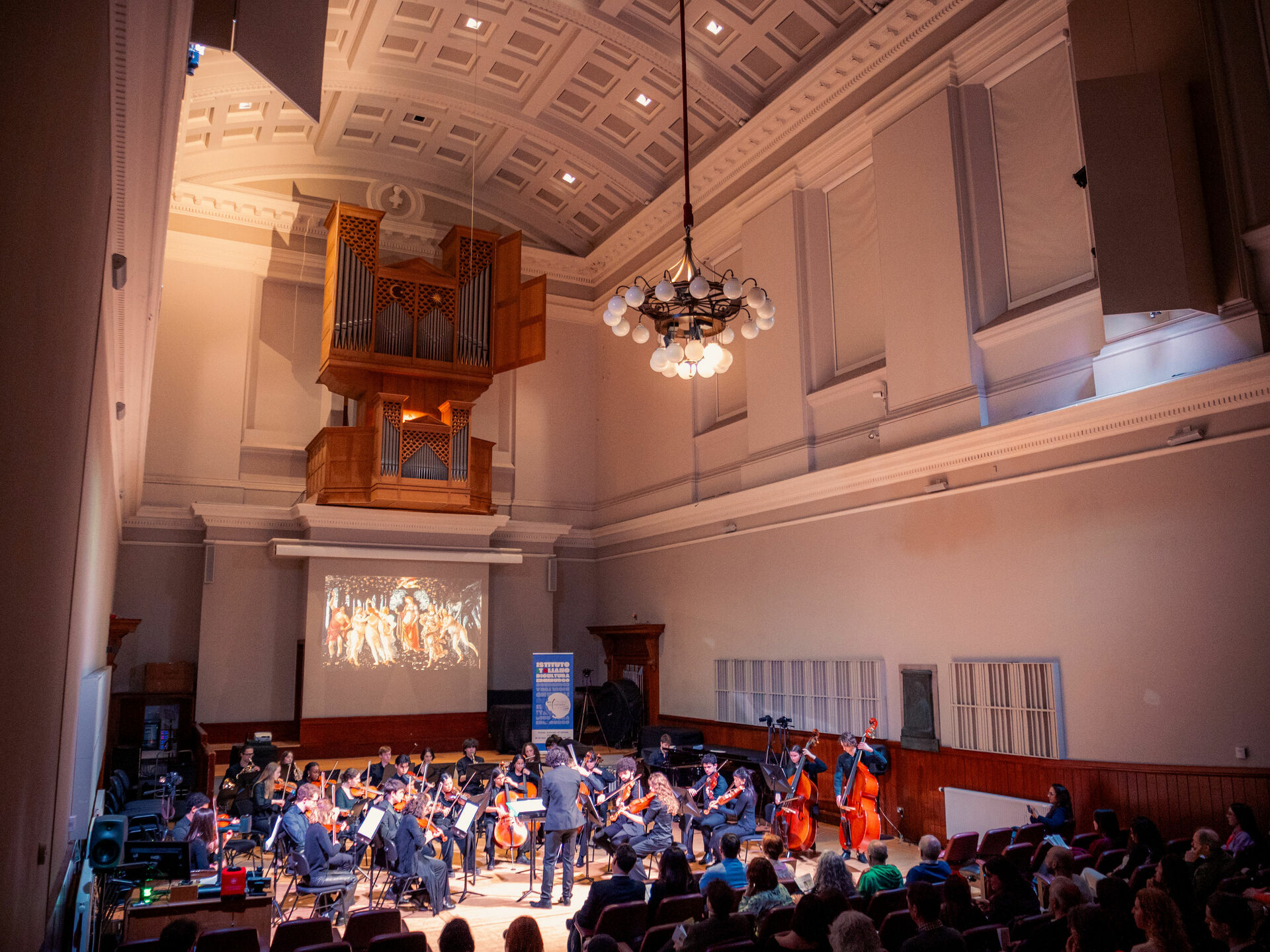
About
Join us in May for a celebration of wonderful music!Edinburgh University Chamber Orchestra performs in the beautiful, Victorian Reid Concert Hall, built in 1859…
Join us in May for a celebration of wonderful music!Edinburgh University Chamber Orchestra performs in the beautiful, Victorian Reid Concert Hall, built in 1859, in the heart of ancient Edinburgh.
Formed in 1983, EUCO has been collaborating with Scotland's best conductors for over 40 years, including Willian Conway, David Watkins and Philip Higham.
Fresh off of performing with the esteemed Roma Tre orchestra with the Italian Institute of Culture, the orchestra, led by Tim Espin for the second time, cannot wait to share this inspiring music with you!The Hebrides Overture – MendelssohnMendelssohn whisks us far away from the gentle May summer evenings in Edinburgh to the looming majesty of Fingal's cave.
Inspired by a 1929 trip to Isle of Staffa from which Mendelssohn was left deeply affected, Mendelssohn encapsulates the sense of overwhelming awe he recounts feeling on the trip.
The island was surrounded by large waves, dark skies and formed of imposing basalt columns rising out of the rough sea.
At the time, the cave was approximately 35 feet high and over 200 feet deep."In order to make you understand how extraordinarily the Hebrides affected me, I send you the following, which came into my head there." Mendelssohn sent a sketch of the scenery on his Scotland trip to his sister Fanny in 1829, telling her in many letters of his musical ideas.
In fact, in this letter he event sent a snippet of the eventual theme of the piece.Brahms famously said "I would gladly give all I have written, to have composed something like the Hebrides Overture".
The reputation of this music is not unfounded.
The crashing of the waves, the sense of our own insignificance when compared to nature and the darkness of the sea is captured by Mendelssohn's genius.
The music ends with the waves subsiding, leaving us bobbing amongst the sea foam.Overture, Scherzo & Finale – SchumannSchumann wrote this wonderful work invoking spring in May having just married Clara. 1841 was his great orchestral year — the year he finally turned from the piano and from song to the full orchestra, and the music came pouring out.
The Spring Symphony, the first draft of what would become the Fourth Symphony, and this piece, all written in a matter of months.
It is the music of a man in love, newly married, and bursting with creative ambition.But what exactly is it? Schumann himself wasn't entirely sure.
He considered calling it a symphony, toyed with "Sinfonietta," and at one point suggested the overture might stand on its own.
In the end, the title simply describes what you get: three movements, each with its own character, bound together by a sense of momentum and joy.
It has the weight and seriousness of a symphony without quite declaring itself one — think of it as Schumann in a rare mood of playfulness about form, giving himself permission to write orchestral music that didn't need to carry the Beethovenian burden of the word "symphony."The Overture opens with a slow, searching introduction before launching into music of restless energy.
The Scherzo is quicksilver — darting, unpredictable, full of the rhythmic surprises that are Schumann at his most characteristic.
He asks that it flow directly into the Finale without a pause, and you can hear why: the Finale picks up the momentum and drives it forward with fugal writing that builds to a thrilling close.
There is a confidence in this music that is infectious, the sound of a composer discovering what the orchestra can do and delighting in every new possibility.Tänzchen im alten Stil – KorngoldKorngold was a composer who managed to span several eras of musical history.
Hailed as a child prodigy by the likes of Mahler and Strauss, later maturing into one of the most prevalent composers in the Weimar Republic of the 1920s, Korngold fled persecution to the United States, where he transformed Hollywood, composing some of the most famous movie scores of the Golden Age.
He is a composer who lives on in the memories of many film composers today (maybe most notably in John Williams' Star Wars).Ma mère l'Oye - RavelRavel's house at Montfort-l'Amaury was absolutely crammed with miniatures: tiny furniture, little mechanical toys, and even a miniature Japanese garden that he looked after alone.
He was a man with a fixation about smallness and perfection.
Ma mère l'Oye serves as a real expression of this conviction he had: it is music through the eyes of a child, music made smaller; music where every detail is meticulously placed with the upmost care.
It is a world delicately crafted for a child.Ravel wrote Ma mère l'Oye in 1908 as a piano duet for four hands, dedicated to Mimie and Jean Godebski, the young children of some close friends.
It was written for pianists with small hands so for Ravel, naturally, two girls aged six and ten gave the premiere.
Three years later Ravel was faced with the task of orchestrating the suite.
How could he turn what was originally composed as a duet for children into an expansive work for orchestra?Ravel proves yet again that his mastery of orchestration knows little bounds.
Every corner of the chamber orchestra we writes for is gleaming - instrumental colours paint vivacious scenes into the audience's minds.
The colours almost transcend their own identities - clarinets imperceptibly transforming into oboes in the middle of melodies.
The strings are often used as ornamentation to a lower woodwind foundation.
Every time you expect Ravel to transcribe one piano line to an instrument, he surprises you by writing something completely unexpected.
The result is a dreamlike scene from which instruments emerge and recede, a magical dance that ends in a spellbinding finale.Ravel: Ma Mère l'Oye - Lucas & Arthur JussenEach movement recounts a children's fairy tale.
We begin with the Pavane of the Sleeping Beauty — a gentle, ancient dance lasting barely a minute.
Subsequently, Tom Thumb wanders through the forest, leaving his trail of breadcrumbs, the music tracing his small, uncertain footsteps (he does not find the breadcrumbs).
Laideronnette, Empress of the Pagodas, takes us to the exotic Far East of Madame d'Aulnoy's imagination, where tiny porcelain figures play music on instruments made of walnut shells — Ravel's orchestration glitters and chatters with an almost mechanical precision here.
The Conversations of Beauty and the Beast gives us a tender dialogue, the beast's low growl in the bassoon yielding to transformation and a soaring waltz.
Finally, The Fairy Garden unfolds in a slow, luminous crescendo — one of the most beautiful endings in all of music, a sunrise that seems to promise that everything will be well forever.There is something deeply touching about Ravel writing this music.
He never married, never had children of his own, and remained one of the most private figures in musical history.
Yet here he is, entering entirely into a child's world of wonder and make-believe, and doing so without a trace of condescension.
He takes the fairy tales completely seriously.
Perhaps that is because, in some way, the world of miniatures, of perfect small things, of enchantment — that was always his world too.Ravel, along with the great Rimsky-Korsakov, was known as a master of orchestration.
Being a French composer (although Basque on his mother's side), he was a patriot, albeit it's in a much quieter way than some of his contemporaries.
He was desperate to serve in WWI, despite being underweight and too old for conscription.
In spite of this he ended up driving an ambulance at Verdun.
His mother died during the war, a completely devastating event in his life from which he never truly recovered, leading to a shift in his music.
We know very little about his immensely private personal life.
Organiser
Reid Concert Hall
Accommodation nearby
Available hotels and Airbnbs near Reid Concert Hall